
Web It Square

Author name: deepakranim78

Founder of Web It Square — a Mumbai-based WordPress development and SEO agency helping Indian small businesses, freelancers, and startups grow online. Specialises in WordPress websites, Local SEO, and Google Business Profile setup.

why your business needs a wordpress website
WordPress Guides

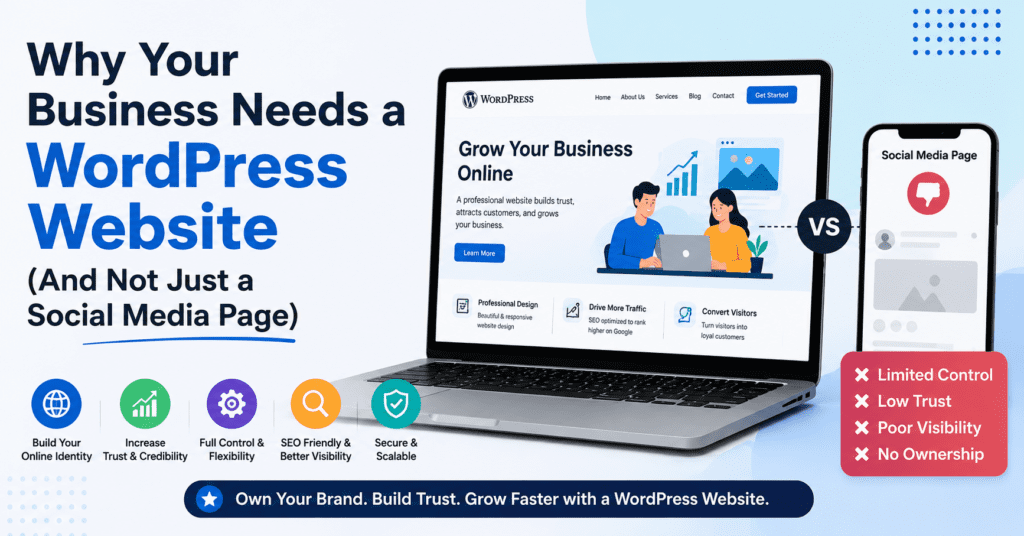
Why Your Business Needs a WordPress Website (And Not Just a Social Media Page)

Why Your Business Needs a WordPress Website (And Not Just a Social Media Page) You have 2,000 Instagram followers. Your WhatsApp Business number is saved in hundreds of phones. Enquiries trickle in. Business feels okay. So why does growth feel stuck? Here’s the uncomfortable truth: Instagram is not your business. It’s a shop you’re running inside someone else’s mall — and that mall can lock you out tomorrow without any warning. A WordPress website is different. It’s your own plot of land on the internet. You own it. Nobody can take it away. And unlike an Instagram post that gets buried in 24 hours, a well-built WordPress website keeps working for your business while you sleep. This article breaks down exactly why your business needs a WordPress website — not just for credibility, but for growth, leads, and long-term survival in a competitive market. Before we dive in, consider these three facts: If you don’t have a website, you are invisible to almost half of all Google searches. Let that sink in. Every business owner asking “why your business needs a WordPress website” usually gets a generic answer. This article gives you the real one. What Happens When Your Business Has Only a Social Media Page Let’s talk about something most people don’t think about until it’s too late. In 2021, a home baker in Pune had built her entire business on Instagram. 8,000 followers. Consistent DMs. A full order calendar. Then one morning, she woke up to find her account had been disabled — no reason given, no warning, no appeal option that actually worked. Three years of content, customer relationships, and brand building — gone overnight. This is not a rare story. It happens every single day to real businesses. When your only online presence is a social media page, you are building on borrowed land. Here’s what that actually means: Instagram and Facebook can restrict or ban your account at any time. Their community guidelines are vague enough that even a competitor’s false report can get you suspended. You have no contract with Meta. You have no legal recourse. You simply lose access. Your followers don’t automatically see your posts. Organic reach on Instagram dropped from around 16% in 2012 to roughly 5% today — and it’s still falling. That means if you have 1,000 followers, roughly 50 people might actually see what you post. The rest? They scroll right past because the algorithm decided not to show them your content. To reach your own audience, you have to pay for ads. You cannot be found on Google through a social media page. When someone in Mumbai searches “interior designer in Bandra” or “CA near me in Thane,” Google does not show Instagram profiles in those results. It shows websites. If you don’t have a website, you simply don’t exist for that potential customer. You don’t own your audience on social media. Meta owns your followers. If Instagram shuts down tomorrow — or if you simply want to send an email to all your customers — you can’t do it. You have no email list, no database, no way to directly contact the people who follow you. Credibility is real, and it matters. Think about the last time you were about to spend ₹10,000 or more on a service. Did you feel confident hiring someone who only had an Instagram page? Most customers — especially for higher-value purchases — Google the business before they commit. If they can’t find a website, doubt creeps in. A social media presence is valuable. But it should be the road that leads customers to your website — not the destination itself. Why Your Business Needs a WordPress Website — 7 Powerful Reasons Let’s walk through the core benefits of WordPress for business — especially if you’re currently running everything on social media alone. 1. You Own Your Website — Nobody Can Take It Away When you build a WordPress website on your own domain and hosting, you own 100% of it. The content is yours. The design is yours. The customer data is yours. Nobody can wake up one morning and decide to shut it down. Think of it this way: an Instagram page is a rented flat. A WordPress website is a flat you own. You can renovate it, expand it, paint it any colour you want — and nobody can evict you. Even if your hosting company closes down, you can export your entire website and move it to a new host in a day. Your content, your pages, your blog posts — everything travels with you. Try doing that with Instagram. This is not just about security. It’s about having a long-term digital asset that builds in value over time. 2. WordPress Gives You an SEO-Friendly Website — Instagram Cannot Do This This is arguably the single biggest reason why your business needs a WordPress website. Every day in India, millions of people search Google for services they need. “Best dentist in Koramangala.” “Affordable wedding photographer in Jaipur.” “WordPress developer in Mumbai.” These people are not scrolling Instagram. They are on Google, ready to hire someone — and they will hire whoever shows up on that first page. WordPress is built to be an SEO-friendly website platform from the ground up. Combined with a plugin like Rank Math, it gives you full control over meta titles, descriptions, schema markup, and sitemaps — everything Google needs to rank you. You can optimise every page and blog post for specific keywords, and over time your website builds what’s called “domain authority” — a kind of trust score that Google rewards with higher rankings. According to W3Techs, WordPress is the CMS of choice for the majority of the top-ranked websites in the world — and there’s a direct reason for that. It’s built with clean code, fast loading structure, and SEO best practices baked in from the start. A blog post you write today about “how to choose a reliable

Why Your Business Needs a WordPress Website (And Not Just a Social Media Page) Read Post »

local seo for indian businesses.jpg
SEO (Search Engine Optimization)

Local SEO for Indian Businesses: How to Rank on Google in Your City (2026 Guide)

Local SEO for Indian Businesses: How to Rank on Google in Your City (2026 Guide) Ravi runs a small AC repair service in Thane. He’s been in business for 11 years, has over 200 happy customers, and does genuinely good work. But when someone in his neighbourhood searches “AC repair near me” on a Sunday afternoon, Ravi’s name doesn’t appear anywhere. A competitor who started 8 months ago shows up at the top — with 34 Google reviews and a fully filled profile. Ravi isn’t losing business because of his skills. He’s losing it because of his digital address. This complete guide to local SEO for Indian businesses covers exactly what you need to rank on Google in your city — step by step, no jargon. Whether you run a shop, offer a service from home, or are just starting out as a freelancer, this is how Indian businesses can rank higher on Google Maps and local search without spending a rupee on ads. No fluff. Just what works. What Is Local SEO and Who Needs It in India? Local SEO for Indian businesses is the practice of making your business visible when people nearby search for what you offer. It’s not about ranking on page 1 for “best restaurant in India.” It’s about appearing when someone in Bandra searches “good Chinese restaurant near me” at 8 PM on a Friday. Google uses three signals to decide who shows up in those local results: Your GBP, your website, your reviews, your citations — they all feed into one or more of these three signals. Everything in this guide maps back to at least one of them. Local SEO is different from regular (national) SEO in a fundamental way. A multinational chain might rank for “digital marketing agency” in a broad sense. But if someone in Nagpur searches “digital marketing agency in Nagpur,” they’re looking for someone local — someone they can call, visit, or WhatsApp. That’s your competition. Not the big guys. The other Nagpur agencies. Who needs local SEO in India? Anyone who serves customers in a specific city or area: Think of this as your Google local SEO guide for small businesses in India — whether you run a kirana store in Jaipur, a coaching class in Pune, or a home-based service in Navi Mumbai. The local SEO strategies for Indian businesses in this guide are built around how Google actually ranks local results — Relevance, Distance, and Prominence. Each step targets at least one of these three directly. If your customers come from within your city, local SEO is the highest-ROI marketing you can do — and a large part of it is free. 👉 Want us to handle your local SEO end-to-end? Check out our SEO services. → Step 1: Google Business Profile — The Foundation of Local SEO for Indian Businesses Google Business Profile (GBP) is the foundation of local SEO for Indian businesses — it’s the first thing Google checks when deciding who to show in city-based searches. It’s the card that appears when someone searches your business name, or when you show up in the map pack — those three listings that appear above organic results for local searches. This is how Indian businesses can rank higher on Google Maps and local search: by having a complete, verified, actively managed GBP. Here’s how to do it properly. Claim and verify your profile first Go to business.google.com and either claim your existing listing or create a new one. Many Indian businesses already have auto-generated listings that nobody has claimed. Search for your business name — you may find it already exists. Verification in India usually happens via postcard (takes 5–14 days) or video call. The postcard can be unreliable if your address has complex formatting — building name, wing, floor, flat number. If you don’t receive it in two weeks, request a video verification instead. Important: An unverified profile is invisible in most local searches. Don’t skip this step. Fill every single field This sounds obvious but most businesses stop at name, address, and phone. Don’t. Fill: The India-specific address trick nobody talks about Indian addresses confuse Google. “Plot 14, Sector 7, Kharghar, Navi Mumbai” doesn’t tell a new customer anything about where you actually are. In your business description, add a landmark reference: “Located opposite Kharghar railway station, near Big Bazaar.” This is how Indian customers actually navigate, and Google uses it for relevance matching. Use GBP Posts — most businesses don’t Inside your GBP dashboard there’s a “Posts” feature. Think of it as a mini social media post that shows on your Google listing. Post weekly. Share an offer, announce a new service, post a photo of recent work. It takes 5 minutes and signals to Google that your business is active — which directly helps your ranking. Pre-populate the Q&A section Your GBP has a Q&A section where anyone can ask questions. Here’s the hack: you can ask and answer questions yourself. Write the 5–6 questions you get asked most often — “Do you offer home service?”, “Do you accept UPI?”, “Is parking available?” — and answer them yourself. This saves customers time and adds keyword-rich content to your profile. GBP suspension — the Indian trap GBP suspensions are unusually common in India, often because of address verification mismatches, suspicious edits, or category violations. Signs you’re at risk: your address format is inconsistent across platforms, you’ve made multiple edits in a short time, or your category doesn’t match your actual business. If you get suspended, don’t panic — file a reinstatement request with supporting documents (GST certificate, shop licence, utility bill showing the address). It takes time, but it’s fixable. Step 2: How Indians Actually Search — Hinglish Keywords and Vernacular SEO This is the section that most SEO guides completely ignore — and it’s costing Indian businesses thousands of potential customers. People in India don’t always search in proper English. They search the way they talk. And in India,

Local SEO for Indian Businesses: How to Rank on Google in Your City (2026 Guide) Read Post »

Scroll to Top